
Where Cherry Creek meets the South Platte
Hydroseeding in Denver, CO
Grass seed in a semi-arid city lives or dies by timing. We plan around Denver's rain months and its long snow season.
- No-charge site visits, with every estimate in writing
- Seed mixes picked for your elevation, sun and water
- Estimates that list prep, seed, mulch and slope work separately
Planning a Lawn Around Denver's Weather
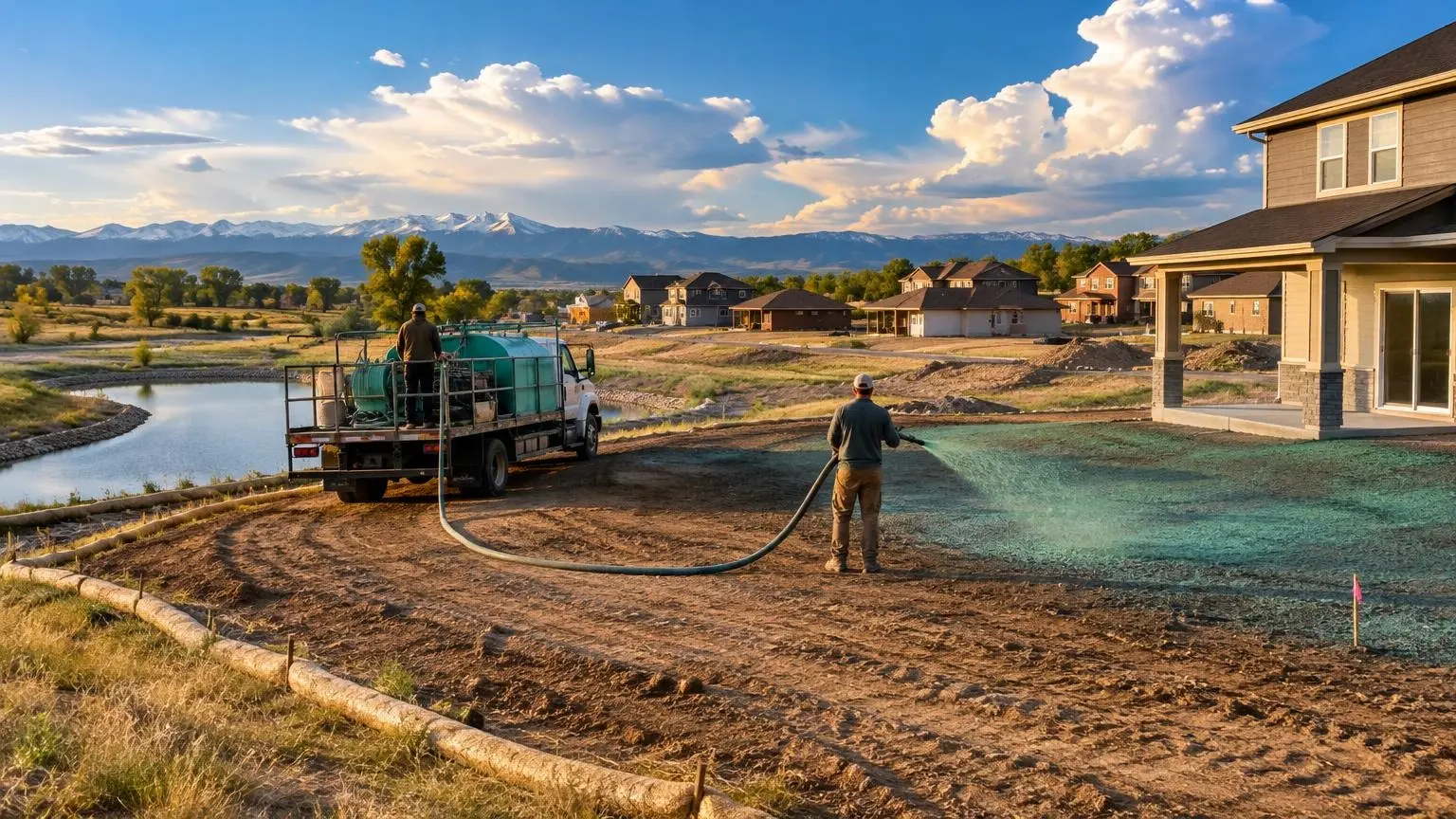
Hydroseeding in Denver comes down to a calendar problem. The city sits in the South Platte River valley on the western edge of the High Plains, where it was founded in 1858 at the confluence of Cherry Creek and the South Platte. Its climate is cool and semi-arid, with roughly 14.5 to 16 inches of precipitation a year in the published climate tables, and most of that falls from April through August. A hydroseed lawn put down with that pattern in mind has a much easier first season than one sprayed in a dry spell.
Why the rain months matter
Hydromulch holds moisture against the seed, but it cannot create water. In Denver we like to have seed and mulch on the ground just ahead of the spring and early summer storms, then back them up with irrigation through the hot weeks. July averages close to 90 degrees for a high, and the city sees around 38 days a year at 90 or above, so a new lawn without a working sprinkler plan will struggle by midsummer.
The snow window
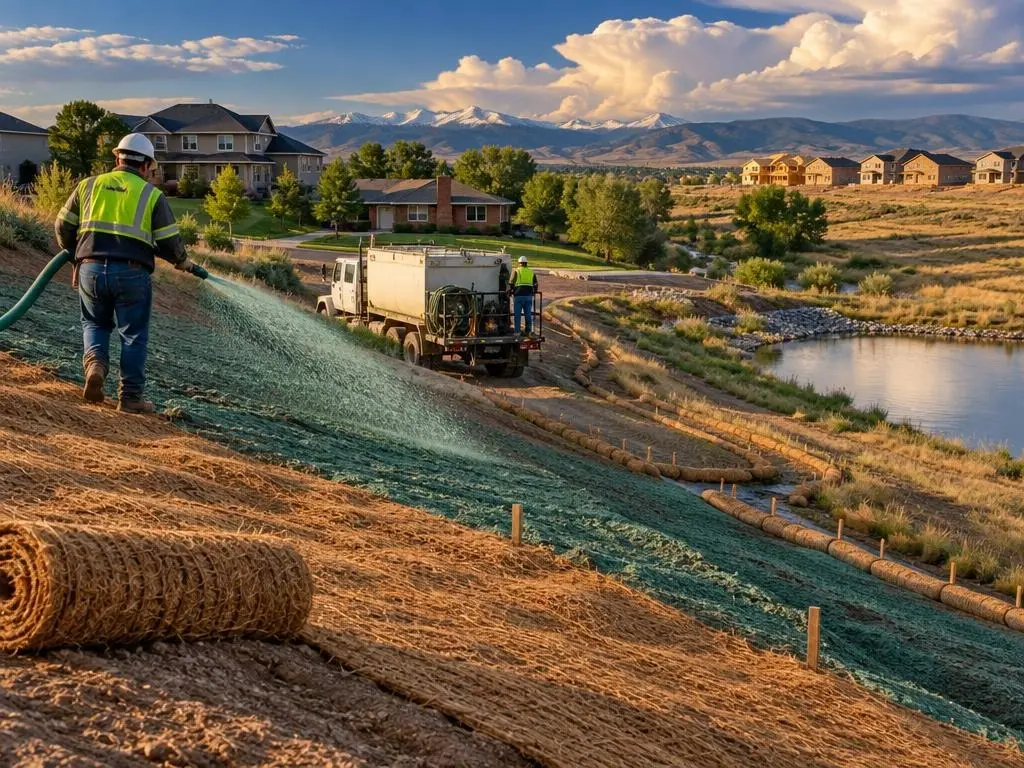
Measurable snow usually falls between mid-October and late April, and it has shown up as early as September 4 and as late as June 3. That long window shapes our fall work. Late seeding can go in as a dormant seeding that waits under mulch for spring, but on bare grades that will sit open through winter we usually add straw blankets or a heavier hydromulch so wind and snowmelt do not strip the soil before the seed wakes up.
Redeveloped ground
Large parts of the city are rebuilt land. The old Stapleton airport site has become the Central Park neighborhood, and infill lots across older neighborhoods get scraped and rebuilt every year. Graded fill and compacted construction subgrade rarely grow good turf on their own. Before any lawn seeding we check depth of topsoil, rip compacted areas and bring in screened topsoil where the builder left subsoil at the surface.
Construction sites in the city
On active jobs, Denver sites need sediment kept out of streets and storm drains. We install silt fence along the low side of disturbed ground, add inlet protection at curb inlets, and follow up with hydromulch or bonded fiber matrix once final grade is reached so the site can stabilize.
What we handle in Denver
- New lawn installation by hydroseed on rebuilt and infill lots
- Silt fence, inlet protection and sediment control on construction sites
- Yard grading and topsoil before seeding
- Overseeding and lawn repair for thin, sun-baked turf
Get a free estimate or call (720) 709-1287.
Denver Ground and Weather Facts
- Founding site. Denver was founded in 1858 at the confluence of Cherry Creek and the South Platte River, in the river valley on the western edge of the High Plains.
- Rain season. Denver has a cool semi-arid climate and receives most of its precipitation from April through August.
- Snow window. Measurable snow usually falls from October 17 through April 27, but has been recorded as early as September 4 and as late as June 3.
- Summer heat. July is the warmest month, with an average high near 90 degrees and about 38 days a year reaching 90 degrees or more.
- Airport to neighborhood. The former Stapleton International Airport was replaced by a neighborhood now called Central Park.
Denver Questions
Which month gives a hydroseeded Denver lawn the easiest start?
Late spring is usually easiest because it lines up with the April to August rain season. Late summer into early fall also works if irrigation is ready and the seed has several weeks before cold weather.
Can you hydroseed in Denver after the first snow?
We can put down a dormant seeding with mulch late in the fall, and we often add blankets on bare slopes so the ground holds through winter. Germination then waits for spring.
My new-build lot has hard fill. Will hydroseed grow on it?
Not well. We loosen compacted subgrade and add screened topsoil where needed before seeding, because seed needs loose soil to root in.
Do Denver construction sites need silt fence before seeding?
Disturbed ground that drains toward streets or inlets should have sediment control in place. Our crews set the silt fence and guard nearby storm inlets, then pull both out after the site is stabilized.
Free Estimates in Denver, CO
Free written estimates for Denver lawns and job sites.
Hydroseeding Near Denver
- Hydroseeding in Aurora, CO
- Hydroseeding in Lakewood, CO
- Hydroseeding in Arvada, CO
- Hydroseeding in Westminster, CO
- Hydroseeding in Thornton, CO
- Hydroseeding in Centennial, CO
- Hydroseeding in Highlands Ranch, CO
- Hydroseeding in Castle Rock, CO
- Hydroseeding in Parker, CO
- Hydroseeding in Littleton, CO
- Hydroseeding in Broomfield, CO
- Hydroseeding in Commerce City, CO
- Hydroseeding in Brighton, CO
- Hydroseeding in Northglenn, CO
- Hydroseeding in Golden, CO
- Hydroseeding in Wheat Ridge, CO
- Hydroseeding in Englewood, CO
- Hydroseeding in Lone Tree, CO
- Hydroseeding in Castle Pines, CO
- Hydroseeding in Erie, CO
- Hydroseeding in Superior, CO
- Hydroseeding in Louisville, CO
- Hydroseeding in Ken Caryl, CO