
Slopes, swales and channels
Erosion Control Blankets & Hydromulch in Denver, CO
Keeping soil on slopes through summer cloudbursts until roots can hold it.
- No-charge site visits, with every estimate in writing
- Seed mixes picked for your elevation, sun and water
- Estimates that list prep, seed, mulch and slope work separately
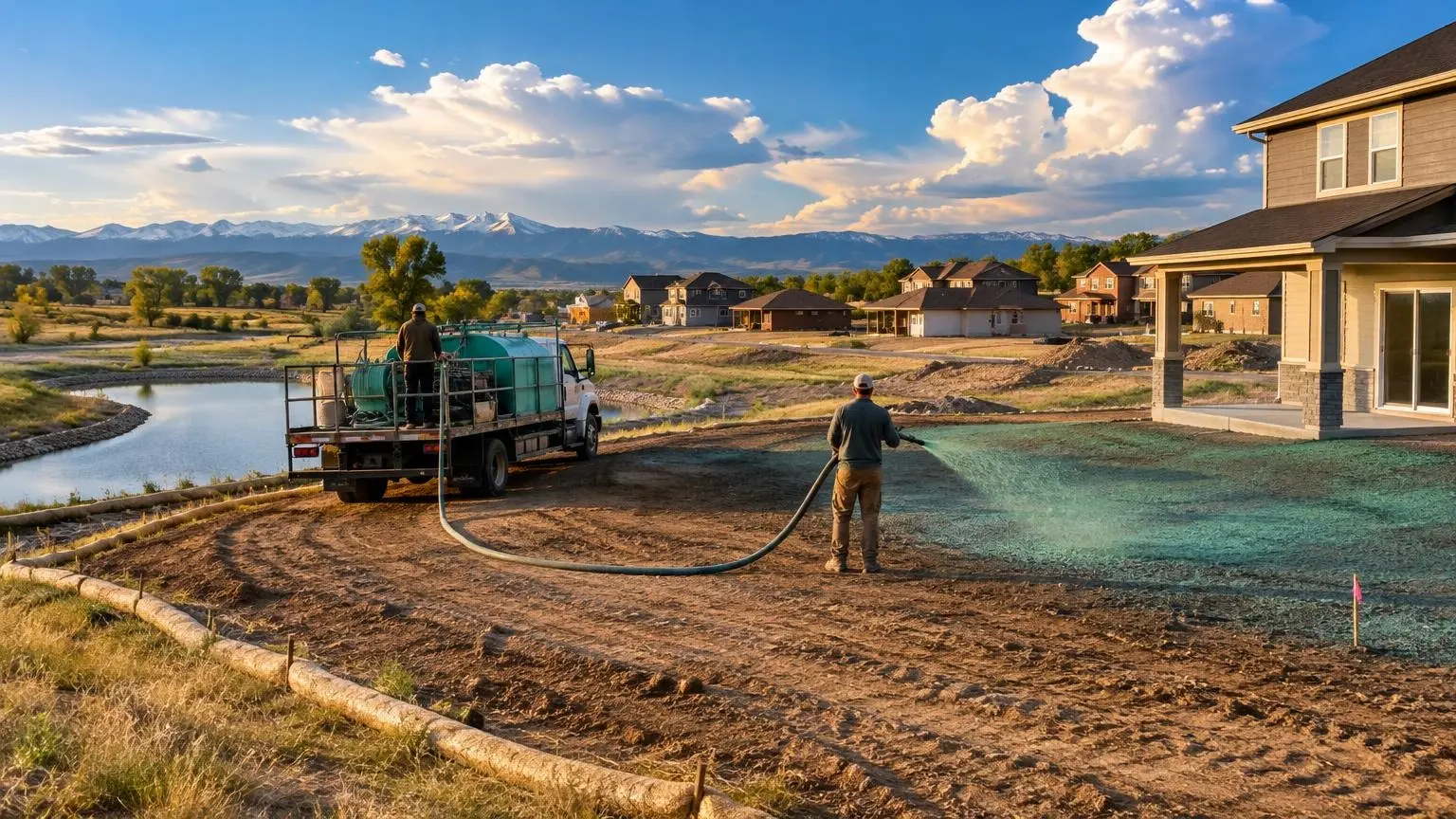
Holding Bare Slopes Through Storm Season
Erosion control blankets and hydromulch are what we use in Denver when seed alone will not stay put: a cut slope behind a new house, a swale that carries the whole subdivision's runoff, a channel bank, or a hillside on the west side of the metro where the ground rises toward the foothills. These erosion control services cover the soil immediately, slow the water down and keep the seed in place long enough to grow.
Why Denver slopes wash out
Denver's dry months are not the problem. The trouble comes from April through August, when the area gets most of its precipitation, and much of it arrives as heavy afternoon thunderstorms, sometimes with hail. Rain falling hard on bare, compacted soil does not soak in; it sheets off and carries soil with it, cutting rills that grow into gullies with each storm. A slope seeded in May with nothing on it can be scoured to bare subsoil by July.
Choosing the cover
The right product depends on the slope, how much water crosses it and how long it needs to last.
- Standard hydromulch: wood fiber mulch sprayed with the seed. Fine for gentle slopes and flat ground.
- Heavier hydromulch with tackifier: more mulch per acre for moderate slopes and wind-exposed sites.
- Bonded fiber matrix (BFM): a hydraulically applied mulch that bonds into a continuous layer, used on steeper slopes where blankets are hard to anchor or rock makes stapling difficult.
- Straw blankets: straw stitched into netting, rolled out and stapled. A common choice for slopes and swales.
- Straw and coconut (coir) blankets: longer lasting, for steeper slopes and channels that see real flow.
- Coir blankets: the longest-lasting natural option for channels and banks that need protection for more than one season.
Installing a blanket correctly
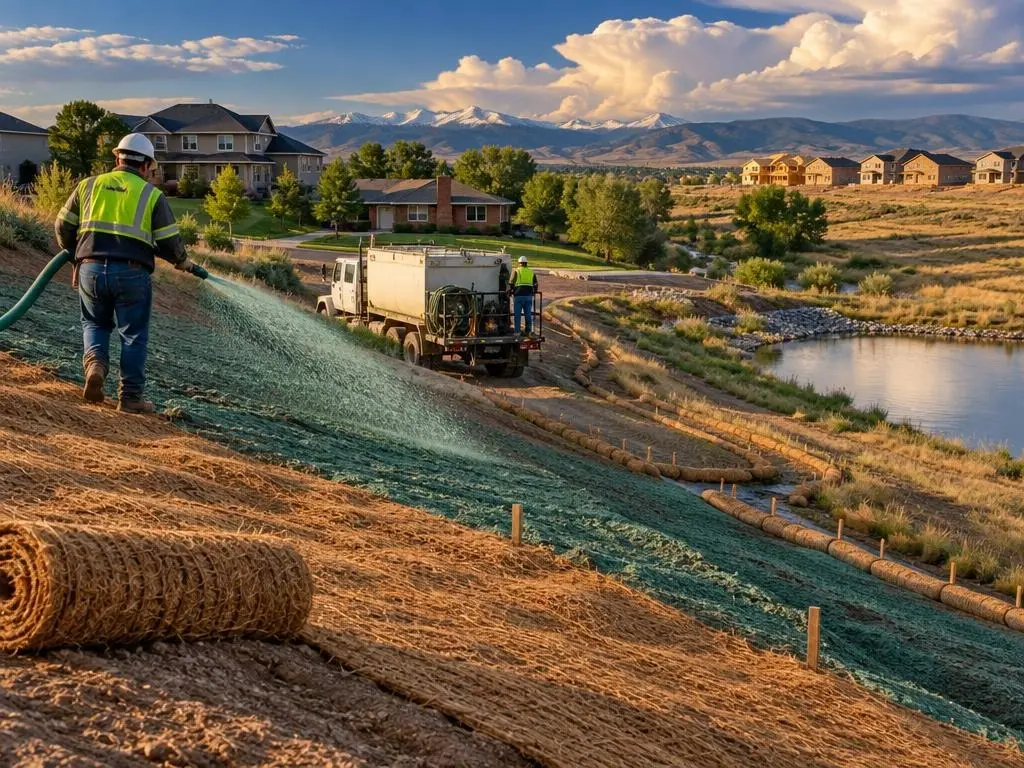
Most blanket failures come from installation, not the product. The soil is graded smooth and seeded first, the top of the blanket is buried in a trench at the crest of the slope, rolls run down the slope rather than across it, edges overlap shingle-style so water cannot get underneath, and staples go in at the pattern the manufacturer calls for. In a channel, the blanket is laid in the direction of flow with check slots across it. Skipping any of those steps is how a blanket ends up in a pile at the bottom of the slope.
Native seed on slopes
On non-irrigated slopes we usually recommend a native dryland mix. Blue grama is the main native grass on plains soils like the USDA's Ascalon series, and CSU Extension lists buffalograss and blue grama as grasses that work for Colorado lawns. Once established, they take far less water than bluegrass, which matters on a slope where irrigation runs off before it soaks in.
Swelling clay and slopes
Many Front Range slopes are cut into clay. The Colorado Geological Survey describes expansive clays that swell when wet and crack when dry, leaving open desiccation cracks at the surface. Those cracks channel water into a slope. A continuous cover of mulch or blanket, followed by roots, keeps the surface from cycling as hard.
Erosion Control Options
Matched to the slope, the water and the time it needs to last.
Slope stabilization
Seeded slopes covered with hydromulch, BFM or blankets.
Straw erosion control blankets
Rolled and stapled blankets for slopes and swales.
Straw-coir and coir blankets
Longer-lasting blankets for steeper ground and channels.
Bonded fiber matrix
Sprayed mulch that forms a continuous bonded layer on steep slopes.
Swale and ditch lining
Blankets laid with the flow, with check slots across the channel.
Washout repair
Rills and gullies regraded, reseeded and covered after storms.
Erosion Control Material Costs
| Item | Rate (2025 erosion unit costs from a state DOT) |
|---|---|
| Blanket, 70% straw / 30% coconut, each 1,000 sq ft | $468 |
| All-coir (coconut fiber) blanket, each 1,000 sq ft | $532 |
| Wood-fiber hydromulch, sprayed, each 1,000 sq ft | $98 |
| Hand-spread loose straw mulch, per 1,000 sq ft | $170 |
| Erosion seeding by hand, per acre | $372 |
| Bonded fiber matrix | No current published figure; we price it once we have seen the slope |
Every rate above is from the same 2025 state DOT list, not from Denver jobs, and slope length, steepness, access and staple pattern differ on each site. These come from cost guides; your job's price is set in our written proposal.
How We Stabilize a Slope
1. Look at the water
We trace where runoff comes from and where it leaves the slope.
2. Repair and grade
Rills filled, the face smoothed and loose material removed.
3. Seed
Native or turf mix applied to the prepared soil.
4. Cover and anchor
Hydromulch, BFM or blankets placed and trenched or stapled.
5. Check after storms
On maintained sites we inspect and repair after heavy rain.
Why Choose Us for Erosion Control Blankets & Hydromulch
Right product, right slope
We do not put a blanket where hydromulch will do, or hydromulch where water will tear it off.
Installed to hold
Anchor trenches, overlaps and staple patterns done properly.
Native seed options
Dryland mixes for slopes that will never be irrigated.
Erosion Control Blankets & Hydromulch Questions
Do I need a blanket or is hydromulch enough?
Gentle slopes with little water crossing them usually do fine with hydromulch. Steeper slopes, swales and anything that carries concentrated flow usually need a blanket or bonded fiber matrix.
Will someone need to pull the blanket off my Denver slope later?
Usually not. The straw or coir fibers rot away in place while the new grass roots through. Some products use plastic netting that outlasts the fibers, so where deer, other wildlife or a mower will cross the area, we can specify a blanket with biodegradable netting instead.
What is bonded fiber matrix?
It is a sprayed-on mulch with a bonding agent mixed in, which cures into a porous, unbroken crust over the seed. It goes on like hydromulch but grips steep ground much better.
When should a slope be stabilized?
As soon as it reaches final grade, and before the spring and summer storm season if possible. Bare slopes in Denver take most of their damage between April and August.
Erosion Control Blankets & Hydromulch Service Areas
- Hydroseeding in Denver, CO
- Hydroseeding in Aurora, CO
- Hydroseeding in Lakewood, CO
- Hydroseeding in Arvada, CO
- Hydroseeding in Westminster, CO
- Hydroseeding in Thornton, CO
- Hydroseeding in Centennial, CO
- Hydroseeding in Highlands Ranch, CO
- Hydroseeding in Castle Rock, CO
- Hydroseeding in Parker, CO
- Hydroseeding in Littleton, CO
- Hydroseeding in Broomfield, CO
- Hydroseeding in Commerce City, CO
- Hydroseeding in Brighton, CO
- Hydroseeding in Northglenn, CO
- Hydroseeding in Golden, CO
- Hydroseeding in Wheat Ridge, CO
- Hydroseeding in Englewood, CO
- Hydroseeding in Lone Tree, CO
- Hydroseeding in Castle Pines, CO
- Hydroseeding in Erie, CO
- Hydroseeding in Superior, CO
- Hydroseeding in Louisville, CO
- Hydroseeding in Ken Caryl, CO
Get an Erosion Control Blankets & Hydromulch Estimate
Send photos of the slope and we will set up a free look.